`
| |
|
Archive for the ‘Design’ Category
Thursday, June 7th, 2012
Following Object Oriented Design Principles have really helped me designing my code:
Along with these principles, I’ve also learned a lot from the 17 rules explained in the Art of Unix Programming book:
- Rule of Modularity: Write simple parts connected by clean interfaces
- Rule of Clarity: Clarity is better than cleverness.
- Rule of Composition: Design programs to be connected to other programs.
- Rule of Separation: Separate policy from mechanism; separate interfaces from engines
- Rule of Simplicity: Design for simplicity; add complexity only where you must
- Rule of Parsimony: Write a big program only when it is clear by demonstration that nothing else will do
- Rule of Transparency: Design for visibility to make inspection and debugging easier
- Rule of Robustness: Robustness is the child of transparency and simplicity
- Rule of Representation: Fold knowledge into data so program logic can be stupid and robust
- Rule of Least Surprise: In interface design, always do the least surprising thing
- Rule of Silence: When a program has nothing surprising to say, it should say nothing
- Rule of Repair: When you must fail, fail noisily and as soon as possible
- Rule of Economy: Programmer time is expensive; conserve it in preference to machine time
- Rule of Generation: Avoid hand-hacking; write programs to write programs when you can
- Rule of Optimization: Prototype before polishing. Get it working before you optimize it
- Rule of Diversity: Distrust all claims for “one true way”
- Rule of Extensibility: Design for the future, because it will be here sooner than you think
Posted in Agile, Code Smells, Design, Programming | 1 Comment »
Friday, May 18th, 2012
These days its fashionable for businesses to have a Facebook and Twitter account. I can see how social media can help them. But what beats me is, every now and then, I see a billboard or a poster with just Facebook and Twitter icons in one corner of their printed ad. What does this mean?



Its like having visiting card like this:

Instead of:

Posted in Crib, Design, Marketing | No Comments »
Monday, March 26th, 2012
Over the last few days, I’ve heard friends complain about Facebook’s timeline (3rd major redesign of the profile page.)
I’m surprised that some people don’t like Timeline. IMHO its very elegantly designed and very “consuming information” friendly. The article: 5 Keys To Creating A UI With Soul explains the thinking process behind the timeline.
Obviously I like other other forms of consuming information like a Twitter stream or a Web page with comments. But I think timeline is neat.
I’m interested to hear from you, what you like or don’t like about timeline? Specific details will help me.
Posted in Design, UX | No Comments »
Tuesday, November 1st, 2011
Many product companies struggle with a big challenge: how to identify a Minimal Viable Product that will let them quickly validate their product hypothesis?
Teams that share the product vision and agree on priorities for features are able to move faster and more effectively.
During this workshop, we’ll take a hypothetical product and coach you on how to effectively come up with an evolutionary roadmap for your product.
This day long workshop teaches you how to collaborate on the vision of the product and create a Product Backlog, a User Story map and a pragmatic Release Plan.
Detailed Activity Breakup
- PART 1: UNDERSTAND PRODUCT CONTEXT
- Introduction
- Define Product Vision
- Identify Users That Matter
- Create User Personas
- Define User Goals
- A Day-In-Life Of Each Persona
- PART 2: BUILD INITIAL STORY MAP FROM ACTIVITY MODEL
- Prioritize Personas
- Break Down Activities And Tasks From User Goals
- Lay Out Goals Activities And Tasks
- Walk Through And Refine Activity Model
- PART 3: CREATE FIRST-CUT PRODUCT ROAD MAP
- Prioritize High Level Tasks
- Define Themes
- Refine Tasks
- Define Minimum Viable Product
- Identify Internal And External Release Milestones
- PART 4: WRITE USER STORIES FOR THE FIRST RELEASE
- Define User Task Level Acceptance Criteria
- Break Down User Tasks To User Stories Based On Acceptance Criteria
- Refine Acceptance Criteria For Each Story
- Find Ways To Further Thin-Slice User Stories
- Capture Assumptions And Non-Functional Requirements
- PART 5: REFINE FIRST INTERNAL RELEASE BASED ON ESTIMATES
- Define Relative Size Of User Stories
- Refine Internal Release Milestones For First-Release Based On Estimates
- Define Goals For Each Release
- Refine Product And Project Risks
- Present And Commit To The Plan
- PART 6: RETROSPECTIVE
- Each part will take roughly 30 mins.
I’ve facilitated this workshop for many organizations (small-startups to large enterprises.)
More details: Product Discovery Workshop from Industrial Logic
Techniques
Focused Break-Out Sessions, Group Activities, Interactive Dialogues, Presentations, Heated Debates/Discussions and Some Fun Games
Target Audience
- Product Owner
- Release/Project Manager
- Subject Matter Expert, Domain Expert, or Business Analyst
- User Experience team
- Architect/Tech Lead
- Core Development Team (including developers, testers, DBAs, etc.)
This tutorial can take max 30 people. (3 teams of 10 people each.)
Workshop Prerequisites
Required: working knowledge of Agile (iterative and incremental software delivery models) Required: working knowledge of personas, users stories, backlogs, acceptance criteria, etc.
Testimonials
“I come away from this workshop having learned a great deal about the process and equally about many strategies and nuances of facilitating it. Invaluable!
Naresh Jain clearly has extensive experience with the Product Discovery Workshop. He conveyed the principles and practices underlying the process very well, with examples from past experience and application to the actual project addressed in the workshop. His ability to quickly relate to the project and team members, and to focus on the specific details for the decomposition of this project at the various levels (goals/roles, activities, tasks), is remarkable and a good example for those learning to facilitate the workshop.
Key take-aways for me include the technique of acceptance criteria driven decomposition, and the point that it is useful to map existing software to provide a baseline framework for future additions.”
Doug Brophy, Agile Expert, GE Energy
Learning outcomes
- Understand the thought process and steps involved during a typical product discovery and release planning session
- Using various User-Centered Design techniques, learn how to create a User Story Map to help you visualize your product
- Understand various prioritization techniques that work at the Business-Goal and User-Persona Level
- Learn how to decompose User Activities into User Tasks and then into User Stories
- Apply an Acceptance Criteria-Driven Discovery approach to flush out thin slices of functionality that cut across the system
- Identify various techniques to narrow the scope of your releases, without reducing the value delivered to the users
- Improve confidence and collaboration between the business and engineering teams
- Practice key techniques to work in short cycles to get rapid feedback and reduce risk
Posted in Agile, agile india, Analysis, Coaching, Conference, Design, Lean Startup, Planning, Product Development, Training | No Comments »
Tuesday, November 1st, 2011
Every single line of code must be unit tested!
This sound advice rather seems quite extreme to me. IMHO a skilled programmer pragmatically decides when to invest in unit testing.
After practicing (automated) unit testing for over a decade, I’m a strong believer and proponent of automated unit testing. My take on why developers should care about Unit Testing and TDD.
However over the years I’ve realized that automated unit tests do have four, very important, costs associated with them:
- Cost of writing the unit tests in the first place
- Cost of running the unit tests regularly to get feedback
- Cost of maintaining and updating the unit tests as and when required
- Cost of understanding other’s unit tests
One also starts to recognize some other subtle costs associated with unit testing:
- Illusion of safety: While unit tests gives you a great safety net, at times, it can also create an illusion of safety leading to developers too heavily relying on just unit tests (possibly doing more harm than good.)
- Opportunity cost: If I did not invest in this test, what else could I have done in that time? Flip side of this argument is the opportunity cost of repetitive manually testing or even worse not testing at all.
- Getting in the way: While unit tests help you drive your design, at times, they do get in the way of refactoring. Many times, I’ve refrained from refactoring the code because I get intimidated by the sheer effort of refactor/rewrite a large number of my tests as well. (I’ve learned many patterns to reduce this pain over the years, but the pain still exists.)
- Obscures a simpler design: Many times, I find myself so engrossed in my tests and the design it leads to, that I become ignorant to a better, more simpler design. Also sometimes half-way through, even if I realize that there might be an alternative design, because I’ve already invested in a solution (plus all its tests), its harder to throw away the code. In retrospect this always seems like a bad choice.
If we consider all these factors, would you agree with me that:
Automated unit testing is extremely important, but each developer has to make a conscious, pragmatic decision when to invest in unit testing.
Its easy to say always write unit tests, but it takes years of first-hand experience to judge where to draw the line.
Posted in Agile, Design, Learning, Programming, Testing | 4 Comments »
Tuesday, November 1st, 2011
Why should developers care of automated unit tests?
- Keeps you out of the (time hungry) debugger!
- Reduces bugs in new features and in existing features
- Reduces the cost of change
- Improves design
- Encourages refactoring
- Builds a safety net to defend against other programmers
- Is fun
- Forces you to slow down and think
- Speeds up development by eliminating waste
- Reduces fear
And how TDD takes it to the next level?
- Improves productivity by
- minimizing time spent debugging
- reduces the need for manual (monkey) checking by developers and tester
- helping developers to maintain focus
- reduce wastage: hand overs
- Improves communication
- Creating living, up-to-date specification
- Communicate design decisions
- Learning: listen to your code
- Baby steps: slow down and think
- Improves confidence
- Testable code by design + safety net
- Loosely-coupled design
- Refactoring
Posted in Agile, Design, Programming, Testing | No Comments »
Sunday, October 9th, 2011
In Software, Quality is one of those badly abused term, which is getting harder and harder to define what it really means. I think we have a sense of quality. When we see something in a specific context, we can say its high quality or low quality, but its hard to define (and hence measure) what absolute quality really is.
You can measure somethings about quality, but don’t fool yourself to believe that IS quality.
Quality is subjective, relative and contextual.
Some might say things like code coverage, cyclomatic complexity and defect density is a good measure of quality. I would argue that those are attributes/aspects of quality, but not quality itself (symptoms not the disease itself.) Its a classic case of Fundamental Attribution Error. (If you go to France and see the first 50 Frenchmen wear glasses, you cannot conclude all Frenchmen wear glasses. Nor can you conclude that, if I wear glasses I’ll also be French.)
BTW people already differentiate between Internal/Intrinsic Quality and External/Extrinsic Quality. This is not enough to complicate things, evangelists would like to further slice and dice quality along different parameters (structural, functional, UX, etc.)
Some anecdotes:
Posted in Agile, Design, Metrics, Programming | No Comments »
Saturday, August 6th, 2011
Consider the following code to retrieve a user’s profile:
public bool GetUserProfile(string userName, out Profile userProfile, out string msg)
{
    msg = string.Empty;
    userProfile = null;
    if (some_validations_here))
    {
        msg = string.Format("Insufficient data to get Profile for username: {0}.", userName);
        return false;
    }

    IList<User> users = // retrieve from database

    if (users.Count() > 1)
    {
        msg = string.Format("Username {0} has {1} Profiles", userName, users.Count());
        return false;
    }

    if (users.Count() == 0)
    {
       userProfile = Profiles.Guest;
    }
    else
    {
        userProfile = users.Get(0).Profile;
    }
    return true;
} |
public bool GetUserProfile(string userName, out Profile userProfile, out string msg)
{
msg = string.Empty;
userProfile = null;
if (some_validations_here))
{
msg = string.Format("Insufficient data to get Profile for username: {0}.", userName);
return false;
}
IList<User> users = // retrieve from database
if (users.Count() > 1)
{
msg = string.Format("Username {0} has {1} Profiles", userName, users.Count());
return false;
}
if (users.Count() == 0)
{
userProfile = Profiles.Guest;
}
else
{
userProfile = users.Get(0).Profile;
}
return true;
} Notice the bool return value and the use of out parameters. This code is heavily influenced by COM & C Programming. We don’t operate under the same constraints these days.
If we were to write a test for this method, what would it look like?
[TestClass]
public class ProfileControllerTest
{
    private string msg;
    private Profile userProfile;
    //create a fakeDB
    private ProfileController controller = new ProfileController(fakeDB);
    private const string UserName = "Naresh.Jain";

    [TestMethod]
    public void ValidUserNameIsRequiredToGetProfile()
    {
        var emptyUserName = "";
        Assert.IsFalse(controller.GetUserProfile(emptyUserName, out userProfile, out msg));
        Assert.IsNull(userProfile);
        Assert.AreEqual("Insufficient data to get Profile for username: " + UserName + ".", msg);
    }

    [TestMethod]
    public void UsersCannotHaveMultipleProfiles()
    {
        //fake DB returns 2 records
        Assert.IsFalse(controller.GetUserProfile(UserName, out userProfile, out msg));
        Assert.IsNull(userProfile);
        Assert.AreEqual("Username "+ UserName +" has 2 Profiles.", msg);
    }

    [TestMethod]
    public void ProfileDefaultedToGuestWhenNoRecordsAreFound()
    {
        //fake DB does not return any records
        Assert.IsTrue(controller.GetUserProfile(UserName, out userProfile, out msg));
        Assert.AreEqual(Profiles.Guest, userProfile);
        Assert.IsNull(msg);
    }

    [TestMethod]
    public void MatchingProfileIsRetrievedForValidUserName()
    {
        //fake DB returns valid tester
        Assert.IsTrue(controller.GetUserProfile(UserName, out userProfile, out msg));
        Assert.AreEqual(Profiles.Tester, userProfile);
        Assert.IsNull(msg);
    }
} |
[TestClass]
public class ProfileControllerTest
{
private string msg;
private Profile userProfile;
//create a fakeDB
private ProfileController controller = new ProfileController(fakeDB);
private const string UserName = "Naresh.Jain";
[TestMethod]
public void ValidUserNameIsRequiredToGetProfile()
{
var emptyUserName = "";
Assert.IsFalse(controller.GetUserProfile(emptyUserName, out userProfile, out msg));
Assert.IsNull(userProfile);
Assert.AreEqual("Insufficient data to get Profile for username: " + UserName + ".", msg);
}
[TestMethod]
public void UsersCannotHaveMultipleProfiles()
{
//fake DB returns 2 records
Assert.IsFalse(controller.GetUserProfile(UserName, out userProfile, out msg));
Assert.IsNull(userProfile);
Assert.AreEqual("Username "+ UserName +" has 2 Profiles.", msg);
}
[TestMethod]
public void ProfileDefaultedToGuestWhenNoRecordsAreFound()
{
//fake DB does not return any records
Assert.IsTrue(controller.GetUserProfile(UserName, out userProfile, out msg));
Assert.AreEqual(Profiles.Guest, userProfile);
Assert.IsNull(msg);
}
[TestMethod]
public void MatchingProfileIsRetrievedForValidUserName()
{
//fake DB returns valid tester
Assert.IsTrue(controller.GetUserProfile(UserName, out userProfile, out msg));
Assert.AreEqual(Profiles.Tester, userProfile);
Assert.IsNull(msg);
}
} This code really stinks.
What problems do you see with this approach?
- Code like this lacks encapsulation. All the out parameters could be encapsulated into an object.
- Encourages duplication in both client code and inside this method.
- The caller of this method needs to check the return value first. If its false then they need to get the msg and do the needful. Its very easy to ignore the failure conditions. (In fact with this very code we saw that happen in 4 out of 6 places.)
- Tests have to validate multiple things to ensure the code is functions correctly.
- Overall more difficult to understand
We can refactor this code as follows:
public Profile GetUserProfile(string userName)
{
    if (some_validations_here))
        throw new Exception(string.Format("Insufficient data to get Profile for username: {0}.", userName));

    IList<User> users = // retrieve from database

    if (users.Count() > 1)
        throw new Exception(string.Format(""Username {0} has {1} Profiles", userName, users.Count()));

    if (users.Count() == 0) return Profiles.Guest;

    return users.Get(0).Profile;
} |
public Profile GetUserProfile(string userName)
{
if (some_validations_here))
throw new Exception(string.Format("Insufficient data to get Profile for username: {0}.", userName));
IList<User> users = // retrieve from database
if (users.Count() > 1)
throw new Exception(string.Format(""Username {0} has {1} Profiles", userName, users.Count()));
if (users.Count() == 0) return Profiles.Guest;
return users.Get(0).Profile;
} and Test code as:
[TestClass]
public class ProfileControllerTest
{
    //create a fakeDB
    private ProfileController controller = new ProfileController(fakeDB);
    private const string UserName = "Naresh.Jain";

    [TestMethod]
    [ExpectedException(typeof(Exception), "Insufficient data to get Profile for username: .")]
    public void ValidUserNameIsRequiredToGetProfile()
    {
        var emptyUserName = "";
        controller.GetUserProfile(emptyUserName);
    }

    [TestMethod]
    [ExpectedException(typeof(Exception), "Username "+ UserName +" has 2 Profiles.")]
    public void UsersCannotHaveMultipleProfiles()
    {
        //fake DB returns 2 records
        controller.GetUserProfile(UserName);
    }

    [TestMethod]
    public void ProfileDefaultedToGuestWhenNoRecordsAreFound()
    {
        //fake DB does not return any records
        Assert.AreEqual(Profiles.Guest, controller.GetUserProfile(UserName));
    }

    [TestMethod]
    public void MatchingProfileIsRetrievedForValidUserName()
    {
        //fake DB returns valid tester
        Assert.AreEqual(Profiles.Tester, controller.GetUserProfile(UserName));
    }
} |
[TestClass]
public class ProfileControllerTest
{
//create a fakeDB
private ProfileController controller = new ProfileController(fakeDB);
private const string UserName = "Naresh.Jain";
[TestMethod]
[ExpectedException(typeof(Exception), "Insufficient data to get Profile for username: .")]
public void ValidUserNameIsRequiredToGetProfile()
{
var emptyUserName = "";
controller.GetUserProfile(emptyUserName);
}
[TestMethod]
[ExpectedException(typeof(Exception), "Username "+ UserName +" has 2 Profiles.")]
public void UsersCannotHaveMultipleProfiles()
{
//fake DB returns 2 records
controller.GetUserProfile(UserName);
}
[TestMethod]
public void ProfileDefaultedToGuestWhenNoRecordsAreFound()
{
//fake DB does not return any records
Assert.AreEqual(Profiles.Guest, controller.GetUserProfile(UserName));
}
[TestMethod]
public void MatchingProfileIsRetrievedForValidUserName()
{
//fake DB returns valid tester
Assert.AreEqual(Profiles.Tester, controller.GetUserProfile(UserName));
}
} See how simple the client code (tests are also client code) can be.
My heart sinks when I see the following code:
public bool GetDataFromConfig(out double[] i, out double[] x, out double[] y, out double[] z)...

public bool AdjustDataBasedOnCorrelation(double correlation, out double[] i, out double[] x, out double[] y, out double[] z)...

public bool Add(double[][] factor, out double[] i, out double[] x, out double[] y, out double[] z)... |
public bool GetDataFromConfig(out double[] i, out double[] x, out double[] y, out double[] z)...
public bool AdjustDataBasedOnCorrelation(double correlation, out double[] i, out double[] x, out double[] y, out double[] z)...
public bool Add(double[][] factor, out double[] i, out double[] x, out double[] y, out double[] z)... I sincerely hope we can find a home (encapsulation) for all these orphans (i, x, y and z).
Posted in Agile, Code Smells, Design, Programming | 1 Comment »
Monday, July 11th, 2011
Till very recently I did not know the clear distinguish between Static/Dynamic and Strong/Weak typing. Thanks to Venkat for enlightening me.
Dynamic typing: Variables’ type declarations are not mandatory and they will be generated/inferred on the fly, by their first use.
Static typing: Variable declarations are mandatory before usage, else results in a compile-time error.
Strong typing: Once a variable is declared as a specific data type, it will be bound to that particular data type. You can explicitly cast the data type though.
Weak typing: Variables are not of a specific data type. However it doesn’t mean that variables are not “bound” to a specific data type. In weakly typed languages, once a block of memory is associated with an object it can be reinterpreted as a different type of object.
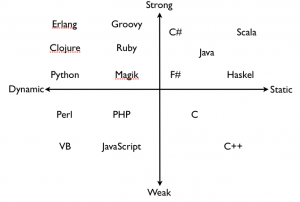
One thing I’ve realized, Strong vs. Weak and Dynamic vs. Static is a continuum rather than an absolute measure. For instance, SmallTalk is more strongly typed compared to Python which is more strongly typed than JavaScript.
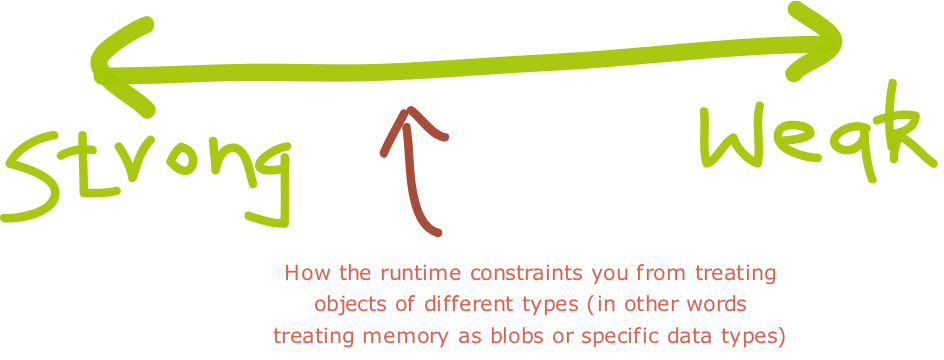
There seem to be two major lines along which strong/weak typing is defined:
- The more type coercions (implicit conversions) for built-in operators the language offers, the weaker the typing. (This could also be viewed as more built-in overloading of built-in operators.)
- The easier it is in a language, or the more ways a language offers, to reinterpret a memory block (associated with a data value) as a different type, the weaker the typing.
In strongly typed languages if you cast to the wrong type, you get a runtime cast exception. While in weakly typed languages, your program might crash if you are lucky. Usually it leads to wrong behavior.
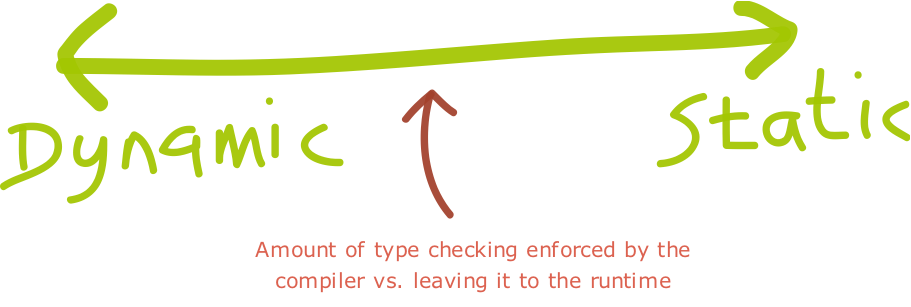
In most static languages you need to specify the data type at declaration. However in languages like Scala, you don’t need to specify the data types, the compiler is smart enough to infer the data types based in the context in which its used.
Also if you don’t have a compiler, then the language is surely dynamic language. However the inverse is not true. For example, Groovy is compiled, yet its a dynamic language.
In Strongly typed Dynamic languages, the type inference is postponed till runtime. This has many advantages:
- One can achieve greater degree of polymorphism
- One does not need to keep fighting the compiler by doing trivial type casting
- One gets greater flexibility by deferring the implementation to a later point. i.e. the actual type verification is postponed to runtime; allowing us to modify the structure of the program between compile time and runtime.
I always thought weakly typed, dynamic language would be a disaster. However both VB and PHP (amongst most popular languages in the last 2 decades) fall into this category.
Having said that, these days I see more and more languages are strongly typed. Also the ability to infer types is gaining a lot of traction.
What do you prefer in your programming language and why?
Posted in Design, Programming, Programming Languages | 3 Comments »
Tuesday, July 5th, 2011
Single Dispatch: In most object-oriented programming languages, the concrete method that is invoked at runtime depends on the dynamic (runtime) type of the object on which the method is invoked.
For Example: If we have 2 cars; Car and derived class RubberCar.
public class Car
{
    public virtual string CrashInto(Wall wall)
    {
        return "Car crashed into the Wall";
    }
}

public class RubberCar: Car
{
    public override string CrashInto(Wall wall)
    {
        return "Rubber Car crashed into the Wall";
    }
} |
public class Car
{
public virtual string CrashInto(Wall wall)
{
return "Car crashed into the Wall";
}
}
public class RubberCar: Car
{
public override string CrashInto(Wall wall)
{
return "Rubber Car crashed into the Wall";
}
} and its test code
[Test]
public void SingleDispathWorksCorrectly()
{
    Wall wall = new Wall();
    Car currentCar = new Car();
    Assert.AreEqual("Car crashed into the Wall", currentCar.CrashInto(wall));
    currentCar = new RubberCar();
    Assert.AreEqual("Rubber Car crashed into the Wall", currentCar.CrashInto(wall));
} |
[Test]
public void SingleDispathWorksCorrectly()
{
Wall wall = new Wall();
Car currentCar = new Car();
Assert.AreEqual("Car crashed into the Wall", currentCar.CrashInto(wall));
currentCar = new RubberCar();
Assert.AreEqual("Rubber Car crashed into the Wall", currentCar.CrashInto(wall));
} First time we call the method CrashInto() on currentCar, we are holding the reference of Car and hence Car’s CrashInto() method is invoked. However the second time, we’re holding the reference of RubberCar in currentCar and CrashInto() method from RubberCar is invoked correctly. In other words this is referred to as Polymorphism.
Its called Single Dispatch because one object’s runtime type (object on which the method is invoked) is used to decide which concrete method to invoke.
Double Dispatch: A mechanism that dispatches a method call to different concrete methods depending on the runtime types of two objects involved in the call (object and its parameter)
Let’s say, we had 2 types of wall, Wall and the derived class MagicWall.
Now when we called currentCar.CrashInto(new MagicWall()) we want to execute different behavior compared to currentCar.CrashInto(new Wall()). One classic way to implement this is:
// Car class
public virtual string CrashInto(Wall wall)
{
    if (wall is MagicWall)
        return "Car crashed into the Magic Wall";
    return "Car crashed into the Wall";
} |
// Car class
public virtual string CrashInto(Wall wall)
{
if (wall is MagicWall)
return "Car crashed into the Magic Wall";
return "Car crashed into the Wall";
} // RubberCar class
public override string CrashInto(Wall wall)
{
if (wall is MagicWall)
return "Rubber Car crashed into the Magic Wall";
return "Rubber Car crashed into the Wall";
} |
// RubberCar class
public override string CrashInto(Wall wall)
{
    if (wall is MagicWall)
        return "Rubber Car crashed into the Magic Wall";
    return "Rubber Car crashed into the Wall";
} This of-course works. However an alternative way to avoid the Switch Statement Smell and to truly use Double Dispatch is:
In Car:
public virtual string CrashInto(Wall wall)
{
    return "Car crashed into the Wall";
}

public virtual string CrashInto(MagicWall wall)
{
    return "Car crashed into the Magic Wall";
} |
public virtual string CrashInto(Wall wall)
{
return "Car crashed into the Wall";
}
public virtual string CrashInto(MagicWall wall)
{
return "Car crashed into the Magic Wall";
} and in RubberCar
public override string CrashInto(Wall wall)
{
    return "Rubber Car crashed into the Wall";
}

public override string CrashInto(MagicWall wall)
{
    return "Rubber Car crashed into the Magic Wall";
} |
public override string CrashInto(Wall wall)
{
return "Rubber Car crashed into the Wall";
}
public override string CrashInto(MagicWall wall)
{
return "Rubber Car crashed into the Magic Wall";
} and its respective test:
[Test]
public void CarCanCrashIntoTheWall()
{
    Wall wall = new Wall();
    Assert.AreEqual("Car crashed into the Wall", new Car().CrashInto(wall));
}

[Test]
public void CarCanCrashIntoTheMagicWall()
{
    MagicWall wall = new MagicWall();
    Assert.AreEqual("Car crashed into the Magic Wall", new Car().CrashInto(wall));
} |
[Test]
public void CarCanCrashIntoTheWall()
{
Wall wall = new Wall();
Assert.AreEqual("Car crashed into the Wall", new Car().CrashInto(wall));
}
[Test]
public void CarCanCrashIntoTheMagicWall()
{
MagicWall wall = new MagicWall();
Assert.AreEqual("Car crashed into the Magic Wall", new Car().CrashInto(wall));
} and
[Test]
public void RubberCarCanCrashIntoTheWall()
{
    Wall wall = new Wall();
    Assert.AreEqual("Rubber Car crashed into the Wall", new RubberCar().CrashInto(wall));
}

[Test]
public void RubberCarCanCrashIntoTheMagicWall()
{
    MagicWall wall = new MagicWall();
    Assert.AreEqual("RubberCar crashed into the Magic Wall", new RubberCar().CrashInto(wall));
} |
[Test]
public void RubberCarCanCrashIntoTheWall()
{
Wall wall = new Wall();
Assert.AreEqual("Rubber Car crashed into the Wall", new RubberCar().CrashInto(wall));
}
[Test]
public void RubberCarCanCrashIntoTheMagicWall()
{
MagicWall wall = new MagicWall();
Assert.AreEqual("RubberCar crashed into the Magic Wall", new RubberCar().CrashInto(wall));
} Believe it or not, this is Double Dispatch in action. Which concrete method to invoke, depends on runtime type of 2 objects (car and wall.)
However there is a catch with this method. If you did the following:
[Test]
public void MethodOverloadingTakesPlaceAtCompileTime()
{
    Wall wall = new MagicWall();
    Assert.AreEqual("Car crashed into the Wall", new Car().CrashInto(wall));
    //   Instead of "Car Crashed into the Magic Wall"
} |
[Test]
public void MethodOverloadingTakesPlaceAtCompileTime()
{
Wall wall = new MagicWall();
Assert.AreEqual("Car crashed into the Wall", new Car().CrashInto(wall));
// Instead of "Car Crashed into the Magic Wall"
} Since MagicWall’s reference is held in wall, which is of type Wall at compile type and overloaded method are bound at compile time, this method behaves unexpectedly.
One way to fix this issue is to use vars in .Net.
[Test]
public void UseOfVarForcesMethodOverloadingToTakesPlaceAtRunTime()
{
    var wall = new MagicWall();
    Assert.AreEqual("Car crashed into the Magic Wall", new Car().CrashInto(wall));
} |
[Test]
public void UseOfVarForcesMethodOverloadingToTakesPlaceAtRunTime()
{
var wall = new MagicWall();
Assert.AreEqual("Car crashed into the Magic Wall", new Car().CrashInto(wall));
} In Languages that don’t support Double Dispatch, one needs to do the following:
[Test]
public void ToAvoidTheConfusion()
{
    Wall wall = new MagicWall();
    Assert.AreEqual("Car crashed into the Magic Wall", wall.CollidesWith(car));
    Assert.AreEqual(0, car.DentCount);
}

[Test]
public void DoubleDispatch_OnWall()
{
    Wall wall = new Wall();
    Assert.AreEqual("Car crashed into the Wall", wall.CollidesWith(car));
    Assert.AreEqual(1, car.DentCount);
} |
[Test]
public void ToAvoidTheConfusion()
{
Wall wall = new MagicWall();
Assert.AreEqual("Car crashed into the Magic Wall", wall.CollidesWith(car));
Assert.AreEqual(0, car.DentCount);
}
[Test]
public void DoubleDispatch_OnWall()
{
Wall wall = new Wall();
Assert.AreEqual("Car crashed into the Wall", wall.CollidesWith(car));
Assert.AreEqual(1, car.DentCount);
} Production Code:
public class Wall
{
    public virtual string CollidesWithCar(Car car)
    {
        return car.CrashIntoWall(this);
    }

    public virtual string CollidesWithRubberCar(RubberCar car)
    {
        return car.CrashIntoWall(this);
    }
}

public class MagicWall : Wall
{
    public override string CollidesWithCar(Car car)
    {
        return car.CrashIntoMagicWall(this);
    }

    public override string CollidesWithRubberCar(RubberCar car)
    {
        return car.CrashIntoMagicWall(this);
    }
} |
public class Wall
{
public virtual string CollidesWithCar(Car car)
{
return car.CrashIntoWall(this);
}
public virtual string CollidesWithRubberCar(RubberCar car)
{
return car.CrashIntoWall(this);
}
}
public class MagicWall : Wall
{
public override string CollidesWithCar(Car car)
{
return car.CrashIntoMagicWall(this);
}
public override string CollidesWithRubberCar(RubberCar car)
{
return car.CrashIntoMagicWall(this);
}
} public class Car
{
public virtual string CrashIntoWall(Wall wall)
{
return "Car crashed into the Wall";
}
public virtual string CrashIntoMagicWall(Wall magicWall)
{
return "Car crashed into the Magic Wall";
}
}
public class RubberCar:Car
{
public override string CrashIntoWall(Wall wall)
{
return "Rubber Car crashed into the Wall";
}
public override string CrashIntoMagicWall(Wall magicWall)
{
return "Rubber Car crashed into the Magic Wall";
}
} |
public class Car
{
    public virtual string CrashIntoWall(Wall wall)
    {
        return "Car crashed into the Wall";
    }

    public virtual string CrashIntoMagicWall(Wall magicWall)
    {
        return "Car crashed into the Magic Wall";
    }
}

public class RubberCar:Car
{
    public override string CrashIntoWall(Wall wall)
    {
        return "Rubber Car crashed into the Wall";
    }

    public override string CrashIntoMagicWall(Wall magicWall)
    {
        return "Rubber Car crashed into the Magic Wall";
    }
} We can expand the same technique to use more than 2 objects to decide which concrete method to invoke at run time. This mechanism is called Multiple Dispatch.
Posted in Code Smells, Design, Programming | 2 Comments »
|