


Goodbye Simplicity; I’m Object Obsessed
In retrospect, I think Object Orientation has tremendously helped me become a better programmer. But at the same time, its also made me vulnerable to including extra complexity (or at least thinking in terms of more complex solutions) in my code.
One of the important lessons I learned a few years ago was, not to try and model my software on real world (my perception of reality). This leads to my software solution ending up as complex and easy to misunderstood as the real world. Soon I started embracing “There is no Spoon” philosophy and really focusing on abstractions.
Last year, I was again caught red handed, trying to sneak in too many objects (and hence complexity) into my code. This time I was pairing with another developer new to TDD and we were building a Snakes and Ladders game using TDD. The focus was really demonstrate TDD in a very different context.
(I’m sure everyone is aware of the Snakes and Ladders board game).
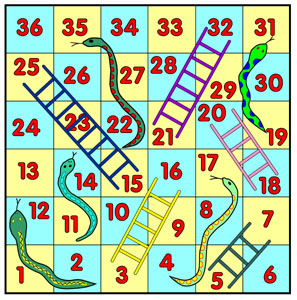
30 mins into the pairing, we had the following classes with wonderful tests for almost each class:
- Game
- Board
- Player
- Dice
- Snake
- Ladder
Just then Sandeep Shetty was passing by and he looked at the beautiful piece of mess we had created. He was surprised how royally we were wasting our time. The following 15 min discussion helped all of us realize how we were so caught up in TDD and coming up with all those (useless) abstractions when simply we could just have
- one class called Game (place holder, the class is not really required) with
- one method called move(int number_on_the_dice)
- a list to hold the current position of each player on the board (there can be more than 2 players)
- a hashmap with starting and ending points on the board (represents both the snakes and ladders, how does it matter whether its a snake or a ladder, they are just starting and ending points on the board)
- a counter to calculate player’s turn
- and … and what? …that’s it
Can you beat the simplicity of these 15 odd lines of code? Its not really about the number of lines of code, its about the conciseness and simplicity of it.
Refactoring Teaser IV is another great example of “Death by Objects” pattern. Solution Summary highlights the real difference.
I would also suggest reading Embrace Simple Design, an analogy and a recent example of Object Obsession.
